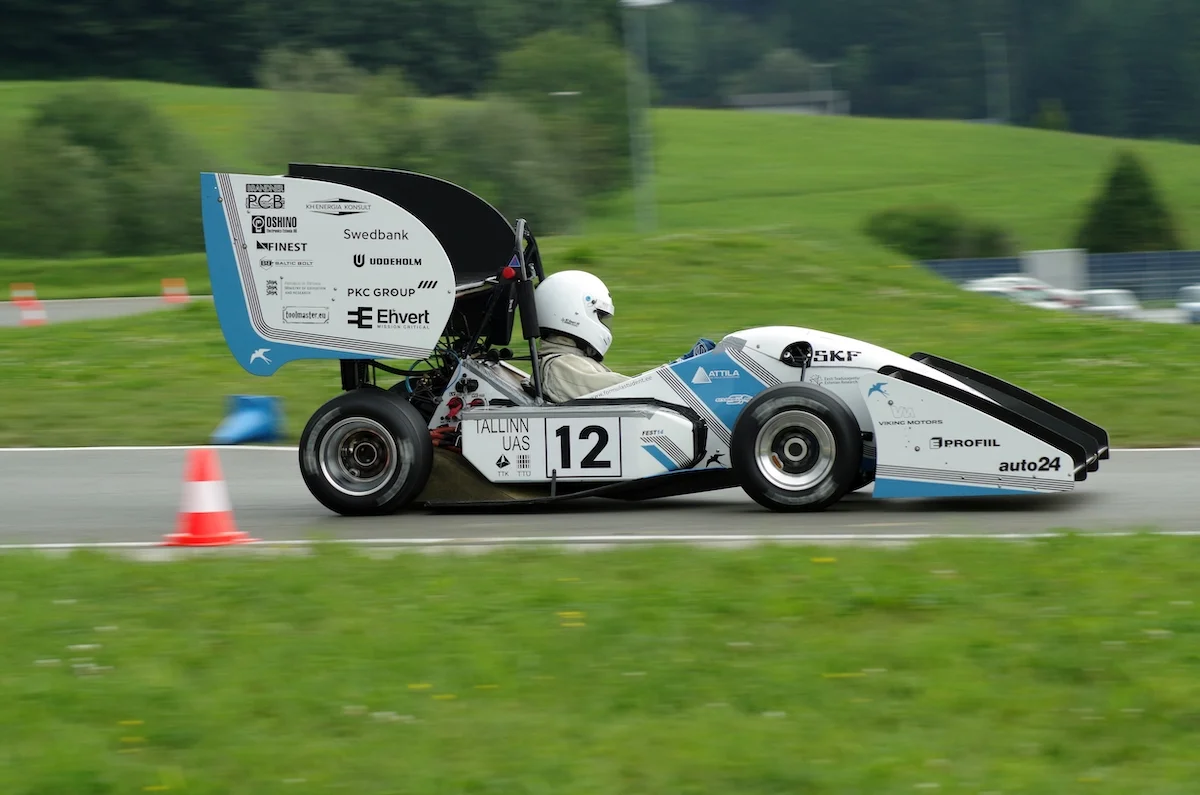
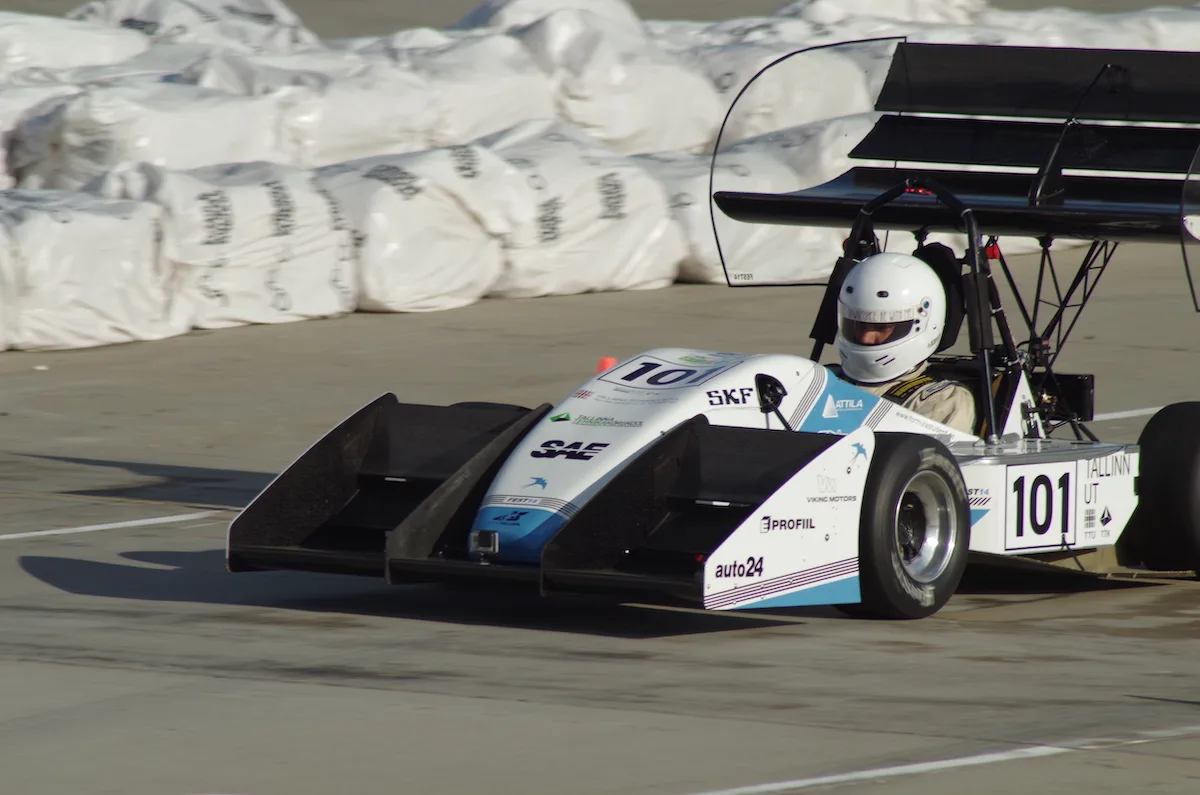
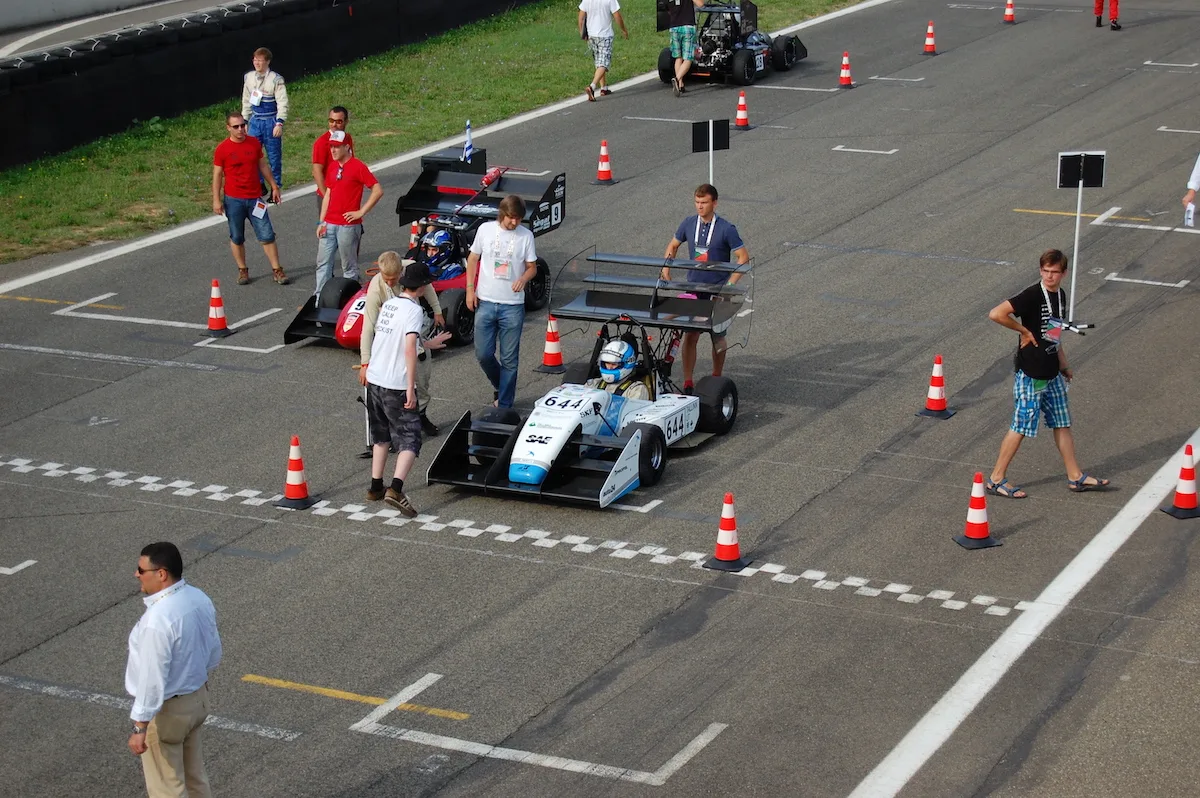
The year 2014 is once again significant for FS Team Tallinn. Last year the decision was made to build an electric-motor formula car for the first time, which reached the first competitions in Hungary in the same season. As you may remember, the competitions did not go in the most successful way – the endurance event, which is essentially the hardest and most heavily weighted of the dynamic events, had to be abandoned. The problems were overheating of the batteries and swelling of the battery cells until they burst. In the season that has just ended, only a year later, came the first overall win. But now, one step at a time.
New members arrived, brought a new heap of motivation, and work on the electric formula continued. FEST13 was taken apart. The frame was stripped bare and put into storage. The competition rules require every new car to differ noticeably from the previous one. This meant designing a new frame and gave the chance to fix, improve or replace altogether several components that had not worked particularly well (or at all). The electronics people set to work with a roar in any case. The number of lines of code, circuit boards, LEDs and so on that these guys wrote/designed/placed/selected was enormous. After nearly half a year of work, FEST14 got onto its wheels on 2 March at 00:25. The frame was finished and most of the suspension components were attached. This major event was followed by more than a month of active scrambling (and wrangling with customs over batteries!), and on 27 April the car was finally drivable. Those first laps in the TTK car park late at night were very proud ones (thank God an electric formula is silent – otherwise we would probably have fallen out with the neighbours again). And with that, another very important milestone was left behind. Now came the testing period and preparation for the competitions. The test period was not painless. Five of our team members were haunted by a call-up to military service. This meant that they had to work and toil, but coming to the competitions would have to be cancelled for them. For the team the situation was very tense, as these were people we very much needed, and we tried to negotiate an extension for them at any price. Under pressure and the effects of sleepless nights, quite a few broke down and some rather costly blunders were made. That is how, for example, the voltage tolerance of the motor controller got tested. We now know, for instance, that 600 V is probably too high for the controller, and if you still want to use the controller, you should not try such a voltage again. Luckily our friends from Latvia helped. The guys there are developing an electric race car and use the same motors and controllers as we do. They had a few lying around in a corner…
The charger also gave up at one point. This meant the batteries needed a babysitter while charging. Fortunately we had specialists and the matter was properly sorted out. The tests progressed, but were shorter than with the petrol-engined formula – exactly as long as there was juice in the batteries. While hunting for the “fish” in the electronics and fine-tuning the mechanics, the competitions came ever closer. The first of them was at our own home, in Estonia. It was our honour to organise Baltic Open, and we decided to hold it in Põltsamaa. A beautiful small town with a suitable kart track right beyond the town limits. Baltic Open was very interesting. In total there were just under 20 cars at the competition, but several times more driving joy. In addition to the usual driving events, there was also an acceleration dependent on reaction speed and a super slalom (as a year earlier at our northern neighbours'). Estonia was represented by as many as four formula cars. We won the reaction acceleration and the second sprint, where the track elements were chosen by the participating teams. Both wins were brought home by FEST14. The endurance event was left unfinished, however, because rainwater got where it should not have and the car stopped on the track. The veterans, who picked up the overall win with FEST10, pulled the chestnuts out of the fire! But unfortunately the Baltic carousel will not come to Estonia next year. Organising such an event is a lot of work, and that is why we are handing the honour to the Swedes or the Danes, who also earned a podium place at the competition.
The first destination – Austria. Cool weather, mud and a terrifying amount of German. The competition was hard. Really hard. German-style strict requirements and rule-following, but much was lacking in German firmness and clarity. One person says one thing, another something quite different. In any case it all began with the technical inspection on the first day of the competition. And continued with it in the evening. And the next day. And the next evening. Everything was checked with painful precision. The biggest problem was the TSAL, or in Estonian the flasher typical of an electric car, which signals when the car's drive system is energised. Namely, it was not visible from every side under the conditions set out in the rules. We solved the situation with transparent plexiglass wing endplates, but this solution did not work. In the end the rear wing simply had to be lowered significantly.
Once the technical inspection was finally passed, the rest generally went smoothly. The presentations were done, the runs were driven, and it can be said that the biggest surprise awaited at the awards ceremony. We got the 2nd-place award for energy efficiency! For the endurance event, to be safe, we had turned the power right down so as to reach the end for certain, and therefore a large part of the battery capacity was left unused. We also got the 3rd-place trophy for the skid pad, the cornering ability test. In total it came to 5th place. Not bad! Not bad at all…
The Hungarian competition followed. Very cool weather for Hungary, rain, but the “Oh Yeah man” in his usual goodness! The technical inspection went better, and we were let onto the track with transparent wing endplates. This meant considerably better aerodynamics than in Austria. The presentations and driving events went relatively well, but the endurance event did not. The start was promising. Based on what we learned in Austria, we could turn the power up and the car literally flew on the track – still the fastest electric car in the endurance event. The driver change worked like clockwork, the car started onto the track again, and after a couple of laps it was taken off. DNF. The TSAL, or flasher, did not work. As this is important safety equipment, we were not allowed to continue. This left a slightly bitter taste, but there was no time to shed tears – the next competition was waiting.
The last destination – Italy. At last warm, sunny and lots of “Italian-style” waving of hands. Now it was our last chance to prove the capability of our essentially first electric formula car. Everything went very well from the start: the static presentations were exemplary, and in the design and business plan presentations we reached the finals. The driving events also went smoothly – in autocross, i.e. the so-called qualifying run, we were the fastest electric car. The awards ceremony again brought a surprise. We received a special award for safe, or more precisely driver-protecting, design. The prize was a plastic 3D-printed copy of an electric power steering unit. But the very, very most important achievement was nevertheless the overall win in the electric formula classification! Yes, champions in Italy at an official Formula SAE competition.
In summary, it can be said that the season that has just ended has been extremely successful. In its second competition year, our first electric formula brought the overall win. This is a fitting moment to praise the capable team members thanks to whom all of this was made possible! We hope that the new season brings new and EVEN more capable ones!